It was clear early on during the state championship Saturday at Ole Miss that officiating was going to be a big topic of discussion as many big calls went against Columbia in its loss to Louisville. After reviewing the tape on all of the controversial calls, it’s clear Columbia has every right to be frustrated. While there’s no way of knowing how different the game would have played out if the correct calls were made, there’s no denying Columbia was robbed of the opportunity to be in the fight for the Class 4A title.
There were 10 different plays in question from the Class 4A State Championship, and we reviewed them all. Five of the 10 were clearly bad calls by the refs, four were questionable and one of them was the correct call.
Columbia head coach Chip Bilderback told C-P Sports Editor Jackson Howell that it’s a shame that the biggest game of the year wasn’t truly about the two teams playing for the state title.
“It’s disappointing and a disservice to both teams to not have the best officiating crew in the state championship. Both teams have worked too hard to not have the best call it,” Bilderback said. “It was evident the MHSAA missed the mark on officiating crews.”
Let’s dig in.
On the opening drive for Columbia, on third-and-10, Jeremiah Foxworth caught a short screen that was stopped five yards short of the first down. However, the defender who tackled him reached into his shoulder pads from behind and pulled Foxworth back to make the tackle. It should have been called a horse collar, a 15-yard penalty that would have given Columbia a first down. Instead the Wildcats were forced to punt. There’s no way of knowing whether Columbia would have scored on the drive, but it didn’t have the chance to try.
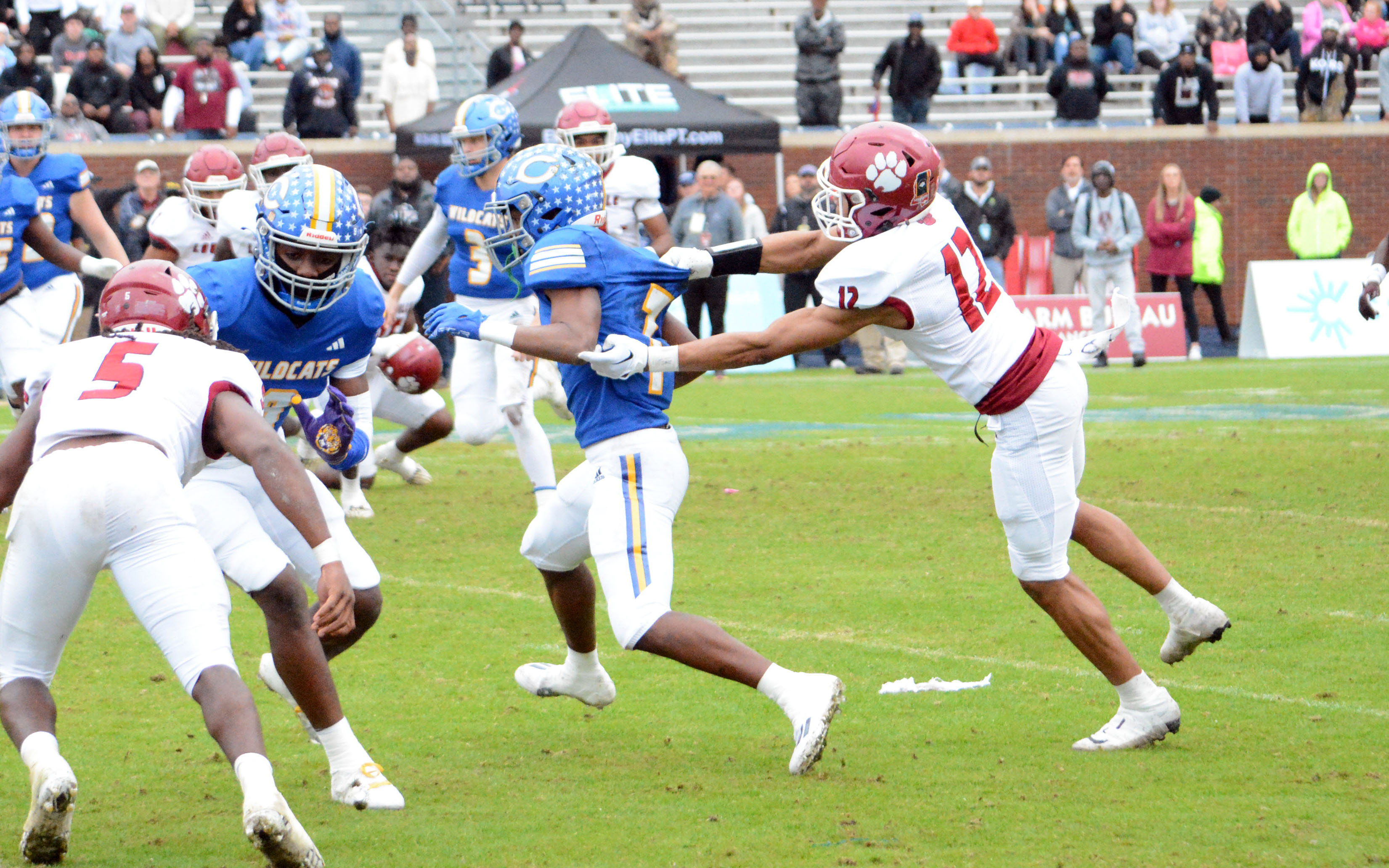 Columbia's Jeremiah Foxworth is brought down by the horse collar Saturday against Louisville.
On Louisville’s second drive, Jeremiah Tatum was flagged for a 15-yard pass interference when he didn’t impede the receiver at all and the ball was overthrown by at least three yards.
Later on that same drive, with Louisville facing a third-and-5, quarterback Xavier Hunt scrambled towards the sideline and was brought down by Jerit Jefferson a yard short of the first down marker. Jefferson first made contact with Hunt inbounds as he was extending for the first down and their momentum carried them out of bounds. Jefferson was flagged for a late hit even though first contact was clearly made in bounds. It would have been fourth-and-1, forcing Louisville to go for it near midfield or punt.
Although Louisville ultimately missed a field goal on the drive, the two penalties proved to be a field position difference of at least 20-30 yards.
Early in the second quarter, when Columbia forced Louisville to punt for the first time, Roderick Curney was flagged for an illegal block in the back. Watching the play in slow motion on film, though, it was clear the contact was shoulder to shoulder and lacked any real force, which is usually the reason that flag flies in the first place. The Louisville player who was hit didn’t even come close to falling down. The play cost Columbia nine yards of field position, which wasn’t necessarily game altering, but it was yet another penalty that shouldn’t have been called.
After Columbia was forced to punt on that drive, Collin Haney booted a perfect punt that went out of bounds at the Louisville 8, which would have forced Louisville to drive 92 yards. However, Columbia was penalized for illegal formation for Tatum not being on the line of scrimmage. While it was borderline, Tatum’s positioning leads most refs not to make that call. Also, when a player isn’t quite on the line, almost every single ref will call out to the player before the play to let him know to scoot up, something I have witnessed at nearly every game I have ever covered on the sidelines. This ref, who coincidentally is the same ref who made the pass interference call on Tatum, the late hit call on Jefferson and the block in the back call on Curney, made no attempt to let Tatum know. Haney’s second punt was fair caught at the 32-yard-line, a difference in 24 yards of field position.
Then the game-changing drive occurred. First, Mac McDaniel came off the edge on a blitz to sack Hunt, which would have backed Louisville up into a third-and-30. However, Columbia was called for a defensive holding, which instead made it second-and-18. While I cannot definitively say that the refs got this one wrong — there’s about a second and a half on film where the secondary is not visible on film before McDaniel wraps up Hunt — I can say that if that holding did occur, it had no effect on the outcome of the play as Hunt was already running for his life and not looking downfield.
Two plays later, on third-and-17, Hunt connected with Kamron Triplett on a deep ball that gained 35 yards and the first down. While that same play would have obviously picked up a first down on third-and-30, it’s much more likely the Louisville coaching staff would have played it safe from its own 37 as opposed to taking a chance downfield from the 50.
A few plays later, Tatum was flagged once again for pass interference. From field level and looking at the replay on the jumbotron, I thought it was a horrible call. But after watching the film, Tatum did grab and pull the receiver at the top of the route. It probably should have been holding instead of pass interference because the ball wasn’t in the air yet, but that’s splitting hairs.
Now let’s talk about the big one. Two plays after Tatum was flagged for pass interference, he had Louisville running back Kendon Sanders wrapped up a yard away from the end zone when Amarion Fortenberry knocked the ball out, which Columbia recovered back at the 21-yard-line. But Tatum was called for a facemask, so instead of Columbia getting a humongous stop and the ball, Louisville got the ball back at the Columbia 1-yard-line.
Looking at it on film, it’s clear that Sanders grabbed Tatum’s facemask and was using it to keep Tatum from wrapping him up. While there was no angle on film to definitively show that Tatum had Sanders’ facemask in his grasp, Sanders’ head does turn slightly. Also, a photographer shooting the game took a photo that does show Tatum’s hand on Sanders’ facemask. It wasn’t nearly as egregious as Sanders grabbing Tatum’s, but it did happen. At the very least, it should have been offsetting penalties. If the ref was using his judgment on which player deserved the facemask call more, he should have called it against Louisville.
On the very next play, Hunt scored on a quarterback sneak where he was pushed into the end zone by a pair of Louisville backs, similar to the “tush push” made famous by the Philadelphia Eagles. While it may seem a bit trivial to make that call, Columbia was flagged for that very thing — aiding the runner — on a fourth-quarter Haney quarterback sneak. If that had been called and Louisville was backed up five yards, Columbia would have had a much better chance at getting the stop and going into halftime down either 6-0 or 9-0 rather than 12-0. On top of the score difference, Columbia would have went into halftime with a lot of confidence and swagger after getting the stop but instead was reduced to feeling like it was being cheated by the refs.
Late in the third quarter, after Louisville went up 19-0, Columbia tried to start its drive with a slant to AJ Lewis, who was bumped and stopped by a linebacker right before the pass from Haney arrived. It should have been called pass interference, but no call was made. Columbia turned it on downs three plays later.
Columbia has had issues with penalties for much of the season, and it seemed like the officiating crew knew that going in and was looking to make calls against Columbia. All the officiating crew really accomplished was robbing these tremendous athletes of a chance to be in the fight.
The Columbia Wildcats had been working toward this game for nearly eight months and had more than 150 workouts and practices leading up to it. That is far too much blood, sweat and tears to not be given a fair shake on the biggest stage. The Mississippi High School Activities Association should be ashamed of itself for allowing an incompetent officiating crew to take the field with so much at stake.
I have no idea if Columbia would have won the game if these calls had been made correctly. Nobody does. But at the end of a championship game, we’re supposed to know who the better team truly is. Sadly, because of the referees Saturday, we still do not know if Columbia or Louisville is outright the better team.